← Back to the coffee market
How Coffee Made It Through the Depression and Into World War II
2026-07-22 · Arabica Republic
Nicaragua
Costa Rica
KC price at time of writing
$3.08/lb
Coffee's path through the 1930s and '40s wasn't one of quietly surviving a financial collapse — it was one of the industries closest to the center of it, kept alive only by direct government intervention on both sides of the war.
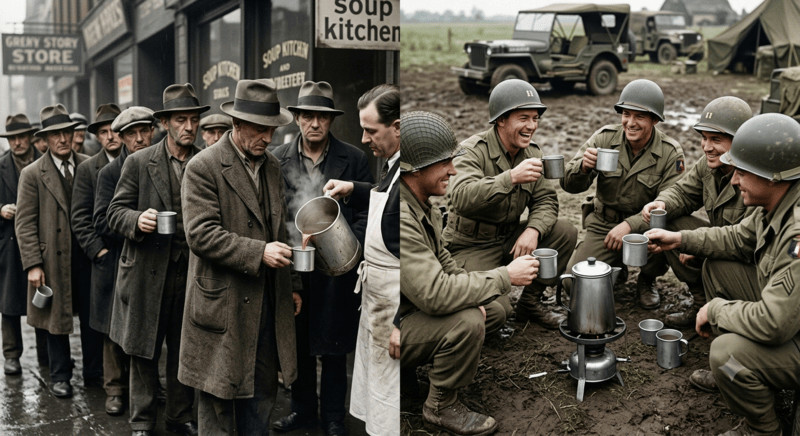
The collapse came first, in the Depression. The 1929 Wall Street Crash cut off Brazilian growers' access to foreign credit at the exact moment another oversized harvest hit the world market. Coffee prices, which had stood at 22.5 cents a pound in 1929, fell to 8 cents by 1931 and eventually to around 5 cents — a price collapse, not a survival story. Brazil's government, unable to sell the surplus, resorted to burning billions of pounds of coffee simply to slow the oversupply crushing the market.
Governments stepped in to fix the price, not the market. By 1940, with European coffee markets cut off by the war and Latin American producers desperate, the U.S. backed the Inter-American Coffee Agreement, setting formal export quotas for Brazil and Colombia into the American market. This was a managed arrangement, not a free one — the goal was keeping Latin American economies tied to the U.S. rather than the Axis powers.
Once the U.S. entered the war, coffee became a fully controlled commodity. The Office of Price Administration fixed coffee prices by December 1941. In mid-1942, Brazil handed over its merchant ships to the Allied war effort in exchange for a guarantee that the U.S. Commodity Credit Corporation would buy its entire coffee quota. By November 1942, coffee was rationed for American civilians — the second food commodity rationed after sugar — because shipping capacity, not finances, was the real constraint once German U-boats made transatlantic cargo runs dangerous.
Coffee didn't dodge the era's financial chaos. It was one of the clearest examples of how far a state was willing to go — price controls, forced purchase guarantees, and consumer rationing — to keep a single commodity's supply chain from collapsing entirely.